
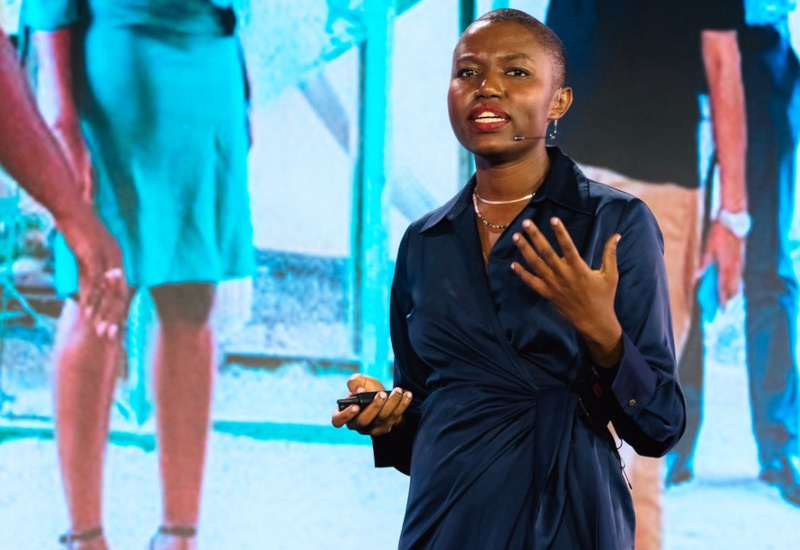
Diana Orembe
Interview with Diana Orembe
CO-FOUNDER AND CEO, NOVFEED
Lives in: Tanzania
This year, Tanzanian entrepreneur Diana Orembe expects her business, NovFeed, to generate well over $1 million in sales. The company produces fish feed and organic fertiliser. In December, Orembe took home first prize in the Africa’s Business Heroes entrepreneurship competition. How we made it in Africa’s editor-in-chief Jaco Maritz spoke to her about how she built the business.
Topics discussed during the interview include:
- Accepting that all businesses are hard
- How to sell to small-scale farmers
- Spotting a business opportunity in fish feed
- Getting the business off the ground
- The hardest part: selling
Watch the full interview below:
** Our new book, How we made it in Africa II: Real stories of entrepreneurs turning opportunity into profit, is available here. **
Interview summary
For Diana Orembe, co-founder and chief executive of NovFeed – a Tanzanian fish feed and organic fertiliser company – one of the core lessons of entrepreneurship is that all businesses are hard.
“If you talk to a woman selling vegetables on the markets, she will tell you how hard it is to run her business. If you talk to a person running a conglomerate, he will just say the same [about] how difficult it is to run that very huge, big business. If you talk to a medium-scale business person who is even running just a store, they will tell you the same [about] how it’s difficult. So what I was just reminding myself this morning is that all businesses are difficult,” she explains.
Instead of searching for an easier path, Orembe keeps in mind that the grass isn’t greener elsewhere – every type of enterprise comes with its own set of problems.
The origins of NovFeed
Orembe grew up close to Lake Victoria – Africa’s largest freshwater lake. “We used to wash our clothes [and] fetch water directly from the lake,” she remembers.
It was there she watched her uncle run a small-scale fish farm, frequently complaining about the high cost and general scarcity of fish feed.
While studying microbiology at the University of Dar es Salaam, Orembe researched the aquaculture sector in Tanzania. She realised that the problems her uncle had complained about were still prevalent across the industry. The country was heavily dependent on imported fish feed, which kept prices high.
Determined to create an affordable local alternative, she relied on the University of Dar es Salaam’s laboratory to conduct her initial research and develop a minimum viable product. She officially launched NovFeed in 2020.
The business converts food waste collected from local markets into fish feed through a natural fermentation process. This process also yields a microbial liquid byproduct that NovFeed sells as fertiliser. In its early days, the company operated out of a small factory with a maximum capacity of 30 tonnes of feed per month.
Sales and distribution
When it came to sales, Orembe’s team kept their messaging simple. They avoided focusing on the exact manufacturing process or using terms like ‘sustainability. “I have learned along the journey that the message you’re giving your customers really matters. When you tell a person that this is bacteria-made fish feed, everyone will run away.”
Instead, the team focused on the benefits, telling prospective clients they had found a better way to produce fish feed at a much more affordable price. The feed sells for $1.30 per kg with a 30% profit margin, and the fertiliser for $3 per litre with a 35% margin.
The company also provides after-sales support to farmers, advising them on general fish farming best practices.
NovFeed’s products are sold through agricultural shops in Tanzania. To get farmers and agro stores interested in the products, the company set up demonstration farms to show them in action. Orembe notes that agro stores typically only want to stock products that farmers already know, rather than risk shelf space on something unfamiliar that will just sit there.
Orembe says it wasn’t until 2024 that she felt she truly had a solid business. For her, that validation came when customers started placing repeat orders. “It doesn’t matter how good your product is, if you can’t retain the customers, it will always be one of the signals that your product is not working,” she explains. “So for us, the moment we started seeing the customer is buying and is coming back, that was a good sign.”
Increasing production
In December, the company won $300,000 in the Africa’s Business Heroes competition. The funding was allocated to increasing the company’s production capacity. Now, with its new factory, NovFeed can produce more than 20 tonnes of fish feed per day.
Orembe is also looking at opening the company’s own network of stores.
In 2024, the business generated $420,000 in revenue. Orembe notes that in 2025, sales doubled. With the new facility operational, she expects revenue to increase by even more than that in 2026.
‘You have to sell’
Despite the recent revenue growth and the new factory, Orembe points out that the challenges never stop. She cites recruitment – acquiring the right talent and managing them – as one of the hardest parts of her job.
But her biggest immediate concern is selling the sheer volume of product the company is now capable of making.
“I’ve never been able to produce 20 tonnes of feed per day … Now where am I going to look for a customer who can access that per day?” she wonders, adding that she worries about whether older leads have already found other suppliers. “All these things have been running into my mind.”
“Being able to produce [is] just one thing,” she adds. “But at the end of the day, you have to sell. That’s the most, most difficult part.”





Recent Comments